
Rate this lesson!
Learning Objective
Students will identify basic tools used by engineers through play.
Learning Resource Synopsis
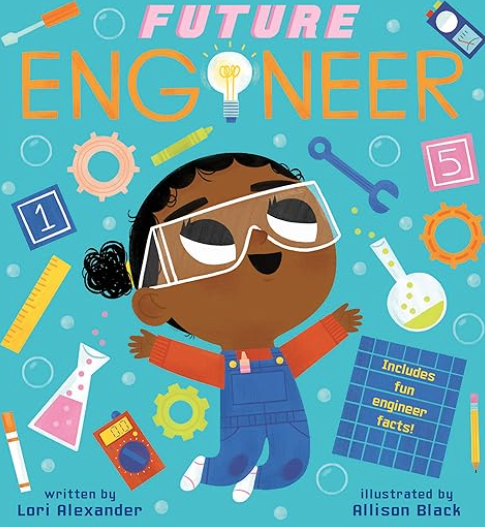
In 'Future Engineer' by Lori Alexander, young readers are introduced to the fascinating world of engineering through the curious eyes of Baby. The book explores the various fields of engineering, such as electrical, mechanical, and civil, and illustrates how a baby's natural curiosity and problem-solving skills are foundational for a future career in engineering. Through playful anecdotes and engaging illustrations, children learn about different engineering concepts and how everyday actions can relate to engineering tasks. This board book is part of the 'Future Baby' series, designed to encourage curiosity and resilience in young learners by connecting their current skills with future careers.
Extended Learning Resources
| Resource & Author | Publication Info | Description |
|---|---|---|
| Rosie Revere, Engineer | Written by Andrea Beaty, published by Abrams Books for Young Readers | This inspiring picture book encourages young readers to embrace failure and curiosity as they explore engineering concepts through the story of a young inventor named Rosie. |
| The Most Magnificent Thing | Written by Ashley Spires, published by Kids Can Press | This story introduces children to the engineering process as a little girl and her canine assistant work through the challenges of creating the most magnificent invention. |
| National Geographic Little Kids First Big Book of Things That Go | Written by Karen de Seve, published by National Geographic Kids | This book offers young readers a visually engaging exploration of vehicles and machines, fostering an understanding of engineering and how different tools are used to build and move things. |
Vocabulary List
| Word | Definition | Example |
|---|---|---|
| Build | Make something with blocks or toys. | Let's build a big tower with blocks. |
| Fix | Make something better or work again. | Uh-oh, the car is broken. Can we fix it? |
| Blocks | Big, colorful toys for stacking and making things. | Can you stack the blocks high, high? |
Prompt
Today, we are going to explore what we can build using blocks. Blocks are like the special tools that little engineers use to create amazing things. Let's discover together how playing with blocks can be full of surprises and fun.
Anticipatory Set
- Start by smiling warmly and showing the children a colorful block. Say, 'Look at this block. It's like a magic tool for building.'.
- Invite the children to touch and hold a block. Say, 'Feel the block in your hand. It's strong and ready to build with.'.
- Ask the children to gently place their block on top of another. Say, 'Let's see what happens when we put them together. What can we make?'.
Teacher Tips
- Use a calm and soothing voice to help children feel safe and welcome.
- Encourage each child to participate by offering a block to hold and explore.
- Observe the children's reactions and gently encourage them to share what they see or feel.
Learn
Welcome to 'Future Engineer' by Lori Alexander. Let's see how a curious baby discovers the fun world of engineering through play.
Interactive Engagement
- Point to the tool. Can you see it?
- Pretend to build. Can you try?
- What's that sound? Tap, tap.
- Point to Baby's big smile.
- Can you clap like Baby?
Teacher Tips
- Use hand gestures to mimic building actions.
- Make sound effects for tools: 'whirr', 'clink'.
- Encourage children to imitate Baby's actions.
Ask
Let's think about what we saw in the story. How did Baby play and build?
Discussion Questions
- How did Baby feel while building?
- What did you like about Baby's play?
- Can you pretend to build like Baby?
Teacher Tips
- Encourage children to show emotions with their faces or hands.
- Invite them to imitate Baby's actions with simple movements.
- Use blocks or toys to help them express what they liked.
Navigate
Engineer Explorers: Building with Block Tools
This hands-on activity invites young learners to step into the shoes of an engineer, inspired by the curious and playful spirit of 'Future Engineer.' Through block play, children will explore the concept of engineering tools, encouraging curiosity and problem-solving as they create and reflect on their own structures. This activity empowers children to see everyday play as a foundation for future engineering skills.
| Materials |
|
| Planning |
|
| Implementation |
|
Teacher Tips
- Encourage peer interaction by suggesting children work together to build larger structures, fostering collaboration.
- Observe the children's play and be ready to offer gentle guidance or suggestions to deepen their exploration.
- Celebrate all creations, emphasizing the process and exploration over the final product to reinforce the theme of learning through play.
Share
As we finish our story about Baby, let's remember all the fun we had learning about building and playing with tools. We used our hands and our ideas just like engineers.
Reflection Questions
- Clap your hands if you liked playing with the blocks.
- Show me how you would use your hands to build something amazing.
- Make a big smile if you felt happy building like Baby.
Teacher Tips
- Encourage toddlers to respond with gestures and expressions like clapping or smiling.
- Model enthusiasm and celebrate each child's response, whether it's a gesture, noise, or a big smile.
- Create a joyful atmosphere by joining in their gestures and making eye contact to reinforce their confidence and participation.
UDL Strategies
Representation
- Introduce a variety of block types and materials, including foam, wooden, and plastic blocks, to give children diverse tactile experiences and help them understand different tool properties.
- Use simple, colorful flashcards with images of engineers and their tools in action, showing how engineers use tools to build and solve problems, to visually introduce the concept.
- Incorporate a short, animated video clip showing engineers at work, with engaging sounds and visuals, to capture attention and explain the use of different tools in an age-appropriate manner.
Action & Expression
- Provide simple recording devices for children to narrate their building process or describe their structures, enabling them to express understanding through audio.
- Set up a photo station where children can take pictures of their creations, which can be displayed in a 'gallery' to share with peers and caregivers, fostering pride and expression.
- Encourage children to collaborate on a group structure, allowing them to express ideas and problem-solve together, building social skills and collective expression.
Engagement
- Set up a 'mystery block' challenge where children are given a special block to incorporate into their structure, encouraging curiosity and experimentation.
- Create a themed building environment, like a 'construction zone,' complete with toy construction hats or vests, to immerse children in the engineer role and boost engagement.
- Introduce a storytelling element where each child becomes a 'block engineer' with a special mission to complete, encouraging imaginative play and a sense of purpose.
Assessment Criteria
Formative Assessment
- Conduct a block play observation where you note each child's engagement with the blocks. Look for specific actions such as choosing different block shapes, experimenting with stacking and balancing, and using blocks creatively to solve problems.
- Engage in one-on-one conversations with children during their play. Ask open-ended questions like 'What are you building?' and 'How did you decide to use these blocks?' to encourage them to verbalize their thought processes and decision-making during construction.
Summative Assessment
- Create a visual portfolio by taking photos of each child's completed block structures. During a group sharing session, ask each child to describe their favorite creation, focusing on the tools (blocks) they used and the creative choices they made.
- Facilitate an engineering journal activity where children draw or assemble a simple diagram of their block structure, using pre-drawn block shapes if needed. Encourage them to label the blocks and share a short, verbal explanation of their building experience, with assistance provided as necessary.